

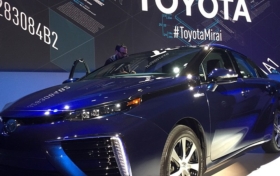
 Editor's note: Today the World Economic Forum's Meta-Council on Emerging Technologies, one of the organization's networks of expert communities that form the Global Agenda Councils, released its Top 10 List of Emerging Technologies for 2015. Bernard Meyerson, chief innovation officer of IBM and author of the following essay, is chair of the Meta-Council. Scientific American editor-in-chief Mariette DiChristina is serving as vice-chair.
Technology is perhaps the greatest agent of change in the modern world. Although never without risk, technological breakthroughs promise solutions to the most pressing global challenges of our time. From zero-emission cars fueled by hydrogen to computer chips modeled on the human brain, this year’s Top 10 Emerging Technologies list—an annual compilation from the World Economic Forum (WEF)—offers a vivid glimpse of the power of innovation to improve lives, transform industries and safeguard our planet.
To compile this list the WEF’s Meta-Council on Emerging Technologies, a panel of 18 experts, draws on the collective expertise of the Forum’s numerous communities to identify the most important technological trends. In doing so, the Meta-Council aims to raise awareness of their potential and contribute to closing the gaps in investment, regulation and public understanding that so often thwart progress.
1. Fuel-cell vehicles
Zero-emission cars that run on hydrogen
Fuel-cell vehicles have long promised several major advantages over those powered by electricity or hydrocarbons. The technology has only now begun to reach the stage where automotive companies are planning launches for consumers, however. Initial prices are likely to be in the range of $70, 000 but should come down significantly as volumes increase within the next couple of years.
Unlike batteries, which must be charged from an external source and can take from five to 12 hours depending on the car and charger, fuel cells generate electricity directly, using hydrogen or natural gas. In practice, fuel cells and batteries are combined, with the fuel cell generating electricity and the batteries storing it until demanded by the motors that drive the vehicle. Fuel-cell vehicles are therefore hybrids and will likely also deploy regenerative braking, which recovers energy from waste heat, a key capability for maximizing efficiency and range.
INTERESTING VIDEO



Share this Post
latest post
-
 CS Website October 14, 2026
 -
 What to study in Computer Science? October 10, 2026
 -
 Useful website for Computer Engineering students October 6, 2026
 -
 Computer Science hardware October 2, 2026
 -
 Web Development Training September 28, 2026
 -
 Computer Science Subjects list September 24, 2026
 -
 What is the meaning of Computer Science? September 20, 2026
 -
 Aptech Computer Education in Delhi September 16, 2026
 -
 ABCya.com kids Education Computer games & Activities September 12, 2026